Thursday, March 14, 2013

Women in the Progressive Era


Stephania Bonnet
Prof: Andrew Mattson
American People II
03/12/13
Women in the Progressive Era
It wasn't the first time that women fought for equal rights in the society and in the progressive era women continued to fight but with and for the nineteenth amendment now called Equal Rights Amendment (ERA). Elsie Hill who supported the Equal Rights Amendment fought for women to gain complete freedom economically, politically, and socially and Florence Kelley who brought important contributions to social reform.
What was the status in the progressive era? They were bound once married to only be real housewives, especially middle-class women. They had to stay home and give birth to children. The second thing that bounded women in the progressive era was the absence of the right to vote. Women had no right choose their own president. That was the reason the nineteenth amendment proposal was supported by so many women.
Voices of Freedom talks about two important figures one fought for the Equal Rights Amendment, Elsie Hill and Florence Kelley. Elsie Hill, daughter of Republican Congressman Ebenezer J. Hill, was born in 1883. She was a graduate student of Vassar College, Hill taught French at a Washington, D.C., high school. Hill was a leader of the D.C. Branch of the College Equal Suffrage League. She led a delegation from the League to meet with President Woodrow Wilson on the suffrage issue shortly after the Congressional Committee of NAWSA staged its huge suffrage parade in the nation's capital in March 1913.Elsie was a ranking member of the House Ways and Means Committee. Hill joined the Congressional Union of Woman Suffrage's executive committee in 1914-15. In August 1918 Hill was arrested for speaking at a Lafayette Square meeting and served a 15-day sentence. She was arrested in Boston in February 1919, where she was picketing Woodrow Wilson upon his return from Europe.
Elsie Hill believed in the Equal Rights Amendment. She wanted to “remove the discriminations against women in the laws of the United States”. She focused on the legal the legal side of the women’s fight. She didn’t agree how the law allowed the men to have more control over children than women, how men would go unpunished for certain things while women would get punish. She was trying to get rid of old traditions that oppressed women.
Among the many famous and powerful women whose names are associated with the Settlement House movement and the Progressive movement of the early 20th Century, one of the most remarkable was Florence Kelley. Florence Kelley was born in 1859 (1932). She was an American social and political reformer. Kelley brought important contributions to social reform used in challenging the status quo of social ills. She married science to moral zeal by developing detailed, scientific studies of child labor in factories, stockyards and sweatshops, and then reporting her solid findings with fiery style and vivid detail of the horrendous abuse of children. For example, she proposed and fought for legal requirements for states to register births, and for employers (rather than desperately poor parents) to document workers’ ages, as steps toward ending exploitative child labor. Enforcement of mandatory school attendance was also a part of the strategy to end child labor.
The victory of the movement of women in the progressive era brought many benefits all the results we are benefiting today; for example, playgrounds for children, women’s voting, minimum wages and more.
Work Cited
Voices of Freedom

Wednesday, February 27, 2013

Sinclair vs. Taylor: But What About the Workingman?


"Let me suggest to Mr. Taylor and his other experts ... what is the really great problem of Scientific Management in our time. Let them set themselves down to figure how the ninety million people residing in the United States of America, and being in full communal ownership and democratic control of the instruments and means of production and distribution, can so organize and administer these instruments and means as to produce the greatest quantity of necessary wealth with the least possible expenditure of labor." (Sinclair, p. 243)

In response to Frederick W. Taylor’s The Principles of Scientific Management, Upton Sinclair writes a provoking critique in the defense of the workingman. To give a brief summary of Taylor’s Scientific Management, his proposed ideas promised great increase in productivity through finding the quickest, most efficient method of performing a certain job and enforcing this method on the laborers. In doing so, Taylor argues that not only will productivity increase but also the employers would be able to increase pay for its staffers with the moneys earned from the extra products sold. In short, both the employer and the employee benefit from Scientific Management.
In response to this, Sinclair argued that Taylor’s Scientific Management was not in favor of the workingman. In particular, when Taylor wrote that a man should be given $1.85 for loading 47 pig irons (having previously been making $1.15 for loading 12.5 pig irons), Sinclair attacked Taylor’s suggestion that the workingman should be given only a 60% increase in pay for a 362% increase in productivity. He mocks how Taylor’s figures do not seem to have any financial basis, or, if it does, that his basis is very skewed in the employer’s favor. (For information on justifying for inflation, go to http://data.bls.gov/cgi-bin/cpicalc.pl)
Sinclair also finds Taylor’s idea, increased productivity leading to men being laid-off being a good thing because they will find work elsewhere, very disturbing; Sinclair believes that the laid-off men will not be able to find work elsewhere because everywhere else will be just as scientifically managed as the place from which they were just let go. Being a notable “muckraker,” founder of the Californian’s chapter of the American Civil Liberties Union, and an open Socialist, Sinclair naturally opposed the idea that the workingmen be laid-off for the sake of something as ethereal as progress—especially when he considered that this progress was being built on the backs of these selfsame workingmen.
Lastly, Sinclair wonders aloud about what will happen with the surplus now being made due to the increase in productivity. Does the productivity outweigh the demand for the product? How can the employer find new consumers for their products? Do they rehire the men they fired to go out and market the surplus products to other communities?
Sinclair notes the slant Taylor has given towards the employer, but ever the Socialist optimist, Sinclair uses his critique to sprinkle more Socialist propaganda and looks to the future saying, “I believe that the time will come when [the workingmen] will take possession of the instruments and means of production, in order that when they produce $1,000 in value they may receive $1,000 in wages” (p. 243)—thus reconciling the Scientific Management with the workingmen’s agenda.
Alternatively, Sinclair opts that Taylor stop pandering to the employer and use his researchers to find out how a workingman can make a good living and sell that research to them for fifty cents so that Taylor can get rich and shut up. Sinclair writes that since the business is built on the backs of the workingman, then the workingman should receive his raise in direct correlation to his productivity, not be laid-off for the sake of progress, and therefore given a better opportunity to make a living for his family.

"And the means which the writer firmly believes will be adopted to bring about, first, efficiency both in employer and employee and then an equitable division of the profits of their joint efforts, will be Scientific Management, which has for its sole aim the attainment of justice for all three parties through impartial scientific investigation of all the elements of the problem." (Taylor, p. 245)


To defend his case, Taylor is given his own turn in the same piece. Taylor argues that Sinclair has only looked at his Scientific Management through the lens of a workingman and not those of the employer or especially the consumer. Taylor starts by taking the side of the employer and defends his only 60% raise by saying that the workingman had before been “incompetent,” and now that the managers have made him competent, or in Taylor’s words “not due to this man’s initiative or originality … but to the knowledge … developed and taught him by someone else” (p. 244-245). In other words, because the workingman did not teach himself how to be more productive he does not receive a better increase in salary than 60% for his greatly increased productivity.
Taylor does not dwell on this subject for long, but jumps right into the consumer’s point-of-view. He gives a lot of pomp about how the consumer gains “the greater part of the benefit coming from all industrial improvements” (p. 244), but he’s really just saying that the more output the company has the lower the prices will be for the product before he gets right back to showing us why the workingman shouldn't be given a raise any larger than 60% of what he’s already making.
Taylor actually has five reasons why the workingman should not get a better raise than 60%. Reason number one, Taylor says that the workingman is not such a hard to come by and actually compares the workingman to an ox, saying that the workingman is “heavy both mentally and physically” (p. 244). Reason number two is that this new work pace does not tire this man out anymore than his previous one, and if it does end up making the workingman more tired clearly the employer is not using the Scientific Management in the way Taylor intended.
The third reason is the same as the one stated beforehand; the workingman should not be paid any more than 60% because it was not his own idea to make himself more competent with his job. It was the employer who made the workingman more productive, so the workingman cannot take credit for, in Taylor’s example, loading more pig iron than before Scientific Management was applied. The forth reason takes this a step further and says that all workingmen should be paid about the same amount of money because “[it] would be grossly unjust to other laborers, for instance, to pay this man three and six tenths as high wages as other men of his general grade receive for an honest full day’s work.” (p. 245).
In Taylor’s last reason, he makes an outrageous claim that employers should not give the workingman more than a 60% raise because, in his words “[our] experiments showed … that for [the workingmen’s] own best interest it does not do for most men to get rich too fast.” (p. 245). Taylor claims that if the workingman does receive more than a 60% increase in pay he will squander it, but if he receives the 60% increase or less then the workingman will be content and save his money. Oddly enough, Taylor forgot that if the workingman does not get a raise in direct proportion to his increased productivity than the employer runs the risk of becoming unfathomably rich too fast. Who is going to protect that poor employer from squandering his wealth? Having finished listing his reasons, Taylor pats himself on the back saying, “[the workingman’s] 60 per cent increase in wages is not an object for pity, but rather a subject for congratulation” (p. 245).
Lastly, Taylor concludes that his Scientific Management’s sole aim is “the attainment of justice for all three parties [the employee, employer, and consumer] through impartial scientific investigation of all the elements of the problem” (p. 245). Taylor does expect that there will be a backlash from the employer and employee, but he believes that eventually the consumer will straighten the two out and Scientific Management will ring in a new, more productive future.

Thursday, February 21, 2013

Masculinity and Self-Assertion as Necessity in Destroying the Color Line


Is it possible, and probable, that nine millions of men can make effective progress in economic lines if they are deprived of political rights, made a servile caste, and allowed only the most meager chance for developing their exceptional men?  W.E.B. Dubois Of Mr. Booker T. Washington and Others 25

In his essay Of Mr. Booker T. Washington and Others, W.E.B. Dubois brings to terms the potential flaws he sees in Booker T. Washington’s ideologies.  The question Dubois poses forces us to recognize the limited nature of Washington’s teachings: if the African-Americans in the South are limited to only learning industrial and agricultural knowledge, how will they ever be able to advance the race beyond the servile nature of their previous existence in the United States.  Without at least the option of higher education for those both willing and capable of its pursuit, the African American people will never be able to develop educators, litigators, political leaders, etc.

Furthermore, Dubois highlights the key differences between the approach taken by Frederick Douglass and other prominent leaders in the African-American community who emerged before Booker T. Washington.

…they recognized the slavery of slaves, but insisted that they themselves were freemen, and sought assimilation and amalgamation with the nation on the same terms with other men…together as men, they said, not as slaves; as “people of color,” not as “Negroes…”  Douglass in his old age, still bravely stood for the ideals of his early manhood,--ultimate assimilation through self-assertion, and on no other terms…Booker T. Washington arose as essentially the leader not of one race but of two,--a compromiser between the South, the North, and the Negro…compromise which surrendered their civil and political rights. 23-24

Unlike Douglass and others who fought for equality with whites- to be seen as people and not as “Negroes,” or any other designation determined for them by whites, Dubois contends that Booker T. Washington concedes to this notion that the color line should exist, and people should be designated by color as opposed to simply being recognized as “people.”  Dubois argument is especially potent, regarding Booker T. Washington’s The Atlanta Exposition Address. “Governor Bullock introduced me with the words, ‘We have with us to-day a representative of Negro enterprise and Negro civilization” (Washington 146).  Washington almost states this proudly, even though the Governor views him solely in the capacity of a “Negro,” and not another human being.  This is incredibly condescending and Washington’s acceptance of this indicates Dubois’ assessment of his overall outlook as having merit.

Dubois also takes a number of shots at Booker T. Washington’s ineffectiveness in asserting himself in a masculine demeanor as well; he defines Washington’s approach as being emasculated: “Mr. Washington’s counsels of submission overlooked certain elements of true manhood…” (22).  Considering his earlier sentiment regarding Douglass’ “bravery” in standing for the “ideals of his early manhood,” Dubois carefully crafts Washington’s argument and “propaganda” as lacking the strength and masculinity of his and other renowned figures in the African-American community.

Lastly, Dubois warns against the damaging effects of Washington’s conceding to the Southern notion that the problem African-Americans now face lies entirely in their own hands.  He claims Washington fails to understand that slavery and prejudice are largely at fault in the current position of the African-Americans in the South; that education was not readily available to African-Americans upon emancipation, because it took time to develop schools and educate their teachers; and although they are capable of advancing their race in many ways themselves, they must still rely on the acceptance, aid and understanding of the whites in the South if they ever hope to make any significant strides forward.  Additionally, opportunities must be afforded to the African-American population, such as higher education and acceptance in political and community roles if any further advancement should be achieved.


Works Cited:
<!--[if !supportLists]-->·         <!--[endif]-->Dubois, W.E.B. "Of Mr. Booker T. Washington and Others." The Souls of Black Folk. 20-29. Kindle.
<!--[if !supportLists]-->·         <!--[endif]-->Washington, Booker T. "The Atlanta Exposition Address." Up From Slavery. Excerpts from Up From Slavery Packet. 146.

Monday, December 17, 2012

Martin Luther King Jr. "I Have A Dream"


During the Civil Rights Movement in the 1960's one man by the name of Martin Luther King Jr had a dream for the Black Americans in the United States. Martin Luther King did not like segregation, he was pro-integration, he wanted to end this thing called racism. During his fight and push to end racism in America, Martin Luther King had this famous "I Have a Dream" speech, which he delivered on August 28th 1963 during the March on Washington. In this speech, Martin Luther King said

 "I have a dream that one day this nation will rise up and live out the true meaning of its creed: 'We hold these truths to be self-evident: that all men are created equal.' I have a dream that one day on the red hills of Georgia the sons of former slaves and the sons of former slave owners will be able to sit down together at a table of brotherhood...I have a dream that my 4 little children will one day live in a nation where they will not be judged by the color of their skin but by the content of their character. I have a dream today."


What makes his speech so important and significant is because it brought Martin Luther King and his message of non-violence to a nationwide & worldwide audience. People heard his speech on the radio and it was also reprinted in newspapers and magazines all over the United States and all over the world. After this speech people really started to pay attention to the civil rights movement that was happening. In a way, his speech made Congress move faster in passing the Civil Rights Act. Although these laws was finally passed in 1964, many of the laws gave African-Americans more equal treatment than they ever had before.

Thursday, December 13, 2012

Litigation: The Scopes Trial Gina Cronin

       The 1925 scopes trial was a famous trial that challenged teaching evolution in schools. A biology teacher in Tennessee named John Scopes was charged for teaching evolution in school, supposedly breaking state law. A key reason as to why this case was so famous was because lawyer Clarence S. Darrow gave such a powerful, hard-hitting defense.
       Sternly he insists that William Bryan's claims that teaching evolution is against the law is simply ignorant. He says "I am going to begin with the simpler reasons why it is absolutely absurd to to think that this statue, indictment, or any part of the proceedings in this case are legal; and I think the sooner we get rid of it in Tennessee the better for the people of Tennessee, and the better for the pursuit of knowledge in the world". He believes that rejecting evolution as a defense for the freedom of Catholicism is ridiculous as the book of Genesis was written during a time when people believed the world was flat. It is important to acknowledge the progress that science makes and not be held back by religion.
        Bryan followed the belief that "to teach that theory denies the story of the divine creation of man as taught in the Bible, and to teach instead that man has descended from a lower form of animal."  A lot of what is in play here, in my opinion, is ego. Man feels that he has a superiority of the earth - Catholicism does not encourage partnership, connection and oneness with the earth - instead it propels a mindset of dominance in which humans are heaven-sent and animals are not. Evolution is a huge blow the the catholic ego. Jennings whole defense hinged on the hysterical disagreement that man descended from a "lower form of life" (whatever that means - for I believe animals are equal and people need to humble the heck down). He says that it isn't fair that these tested scientific theories can be taught but by the law the bible can not.
       Ultimately Bryan won the trial and a law prohibiting the teaching of evolution stayed in the books in Tennessee until 1967. Crazy world.
  

Tuesday, December 11, 2012

Brown v. Board of Education of Topeka, 1954A change in education forever...
In the case of Brown v. The Board of Education was a decision that changed education forever. Linda Brown, a black student from Topeka, Kansas was forced to attend a segregated school that was far from her home because she could not attend the "white" school that was near her home. She fought the Board of Education and argued that segregation is unconstitutional because it denied students "equal protection o the laws." The segregated schools did not have the same quality teachers and schools that the "white" students had. On May 17, 1954 the Supreme Court ruled that "separate but equal" was not equal and had no place in education. This was a triumph for the NAACP and changed schools forever by integrating them.

"The plaintiffs contend that segregated public schools are not "equal" and cannot be made "equal," and that hence they are deprived of the equal protection of the laws."
Diana Bender

 Declaration of Environmental Rights
 "We, therefore, resolve to act. We propose a revolution in conduct toward an environment which is rising in revolt against us. Granted that ideas and institutions long established are not easily changed; yet today is the first day of the rest of our life on this planet. We will begin anew."
Declaration of Environmental Rights, 1970.

Due to an oil leak in 1969 caused by a drilling installation in California, the United States of America created the Declaration of Environmental Rights. The Declaration declared that people need to respect the environment that surrounds them. If people do not have respect for the environment it will disappear and we will not be able to survive.
 "We need an ecological consciousness that recognizes man as member, not master, of the community of living things sharing his environment." I choose this quote from Hofstadter because it reminds people that they are a part of the environment. That they need to respect their surrounds because if they don't, one day it will be gone.

Diana Bender

Thursday, December 6, 2012

Lyndon B. Johnson- Policy in Vietnam


President Lyndon B. Johnson makes a speech on April 7, 1965 addressing the war in Vietnam, his concerns and why it is his goal and the goal of America to help South Viet-nam. President Johnson intentions is to keep a promise in which he offers support to the people in South Viet-nam and promises to defend their independence. A promise that American Presidents have made and kept since 1954. People all over the world depended on President Johnson to help them, God Forbid they were attacked during the Viet-nam war and Johnson refused to let them down.In his address President Johnson mention that:
"We are there because there be great stakes in the balance. Let no one think for a moment that retreat from Viet-nam would bring an end to conflict. The battle would be renewed in one country and then in another. The central lesson of our time is that the appetite of aggression is never satisfied. To withdraw from one battle field means only to prepare for the next". 
This statement to me means that even after a war has ended a countries be cautious and aware of what could happen next. Nations all around the world should be prepared for any conflict that may come their way because there will always be enemies trying to destroy them. So, President Johnson feels as if it is his responsibility to defend and protect the people who are at risk of being hit during the war.

The objectives that were focused on by President Johnson was stop the spread of communism. He believed in the domino theory which states that if one southeast asian territory fell to communism then the rest would follow suit and join the communist territories. President Johnson really wanted the spread of communism to stop throughout these areas. He made a promise to the people of these territories that he would not let communism spread towards their parts and that he would help preserve a land that we had the best intentions for. The ultimate goal was for South Vietnam was to become free from attacks and run their land the way that they saw best. President Johnson did not want to do this in order for the United States to gain something but for the South Vietnamese to live in peace. He also stated later than until things can be talked peacefully through discussions, then force will be necessary to achieve the independence they need.

By Julian Z. and Kiara P.


House Judiciary Committee, Articles of Impeachment


House of judiciary Committee, Article of Impeachment Agustin 20, 1974

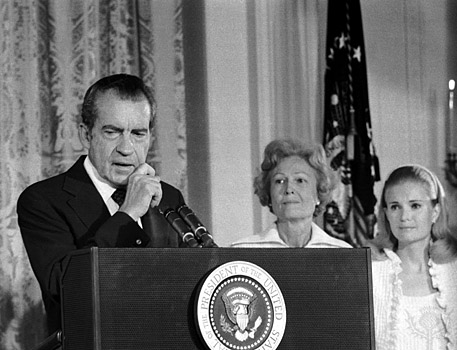
Richard Nixon ran for presidency in 1960, but lost to John F. Kennedy. After running for Governor of California once again and coming up short he stated that he was finished with politics. However, he ran again in 1972, this time, he was successful. Nixon won against Democrat George McGovern by 60 percent of popular votes.

Throughout is Presidency Nixon carried out much dishonestly for personal advantages that were unlawful. During his time in office, President Nixon and his major assistants became deeply involved in illegal activities against the opposing committee.
At first he denied the incident inside the Watergate Office Complex in Washington the democratic national committee headquarters, where five burglars broke-in to try to record the opposing candidate’s conversation to try and get a step up on the competition. They were arrested by the police at 2:30 a.m. The investigators found out that the burglars were employed by President Nixon. President Nixon denied it by stating   "No one in the White House staff, no one in this administration presently employed, was involved in this way bizarre incident”   Nether the less, The House Judiciary Committee began its final debate on the impeachment of President Nixon for his illegal activities surrounding the Watergate scandal on July 24, 1974. They came up with three articles for President Nixon impeachment.


Article 1: Obstruction of Justice.

This article stated that the full House should impeach Nixon for the high crime of deliberately engaging in obstruction of justice by attempting to cover up the Watergate investigation. Nixon Designed to delay, impede and obstruct investigations of such unlawful entry; to cover up, conceal and protect those responsible and to conceal the existence and scope of other unlawful covert activities. Passed by vote of 27 to 11.

Article 2: Abuse of Power.

It charged the president with abuse of powers, in violation of the Constitution, by using the IRS, the FBI, and other government agencies to spy on American citizens. Nixon repeatedly engaged in conduct violating the constitutional rights of citizens, imparting the due and proper administration of justice and the conduct of lawful inquiries, or contravening the laws governing agencies of the executive branch and the purposes of these agencies. Passed by vote of 28 to 10

Article 3: Contempt of Congress.

It charged that Nixon violated the Constitution by ignoring congressional subpoenas of White House documents. In refusing to produce these papers and things, Richard M. Nixon, substituting his judgment as to what materials were necessary for the inquiry, interposed the powers of the Presidency against the lawful orders of the House of Representatives, thereby assuming to himself functions and judgments necessary to the exercise of the sole power of impeachment vested by Constitution in the House of Representatives. Passed by a vote of 21 to 17
By,
Nick Brengel, Shantana Folkes

Senator J. William Fulbright on the Arrogance of Power, 1966


The attitude above all others which I feel sure is no longer valid is the arrogance of power, the tendency of great nations to equate power with virtue and major responsibilities with a universal mission. The dilemmas involved are preeminently American di lemmas, not because America has weaknesses that others do not have but because America is powerful as no nation has ever been before and the discrepancy between its power and the power of others appears to be increasing....


We are now engaged in a war to "defend freedom" in South Vietnam. Unlike the Republic of Korea, South Vietnam has an army which [is] without notable success and a weak, dictatorial government which does not command the loyalty of the South Vietn amese people. The official war aims of the United States Government, as I understand them, are to defeat what is regarded as North Vietnamese aggression, to demonstrate the futility of what the communists call "wars of national liberation," and to create conditions under which the South Vietnamese people will be able freely to determine their own future. I have not the slightest doubt of the sincerity of the President and the Vice President and the Secretaries of State and Defense in propounding these aims. What I do doubt_and doubt very much_is the ability of the United States to achieve these aims by the means being used. I do not question the power of our weapons and the efficiency of our logistics; I cannot say these things delight me as the y seem to delight some of our officials, but they are certainly impressive. What I do question is the ability of the United States, or France or any other Western nation, to go into a small, alien, undeveloped Asian nation and create stability where there is chaos, the will to fight where there is defeatism, democracy racy where there is no tradition of it and honest government where corruption is almost a way of life. Our handicap is well expressed in the pungent Chinese proverb: "In shallo w waters dragons become the sport of shrimps."


Early last month demonstrators in Saigon burned American jeeps, tried to assault American soldiers, and marched through the streets shouting "Down with the American imperialists," while one of the Buddhist leaders made a speech equating the Unit ed States with the communists as a threat to South Vietnamese independence. Most Americans are understandably shocked ant angered to encounter such hostility from people who by now would be under the rule of the Viet Cong but for the sacrifice of American lives and money. Why, we may ask, are they so shockingly ungrateful? Surely they must know that their very right to parade and protest and demonstrate depends on the Americans who are defending them.


The answer, I think, is that "fatal impact" of the rich and strong on the poor and weak. Dependent on it though the Vietnamese are, our very strength is a reproach to their weakness, our wealth a mockery of their poverty, our success a reminder of their failures. What they resent is the disruptive effect of our strong culture upon their fragile one, an effect which we can no more avoid than a man can help being bigger than a child. What they fear, I think rightly, is that traditional Vietnamese society cannot survive the American economic and cultural impact....


The cause of our difficulties in southeast Asia is not a deficiency of power but an excess of the wrong kind of power which results in a feeling of impotence when it fails to achieve its desired ends. We are still acting like boy scouts dragging reluctant old ladies across the streets they do not want to cross. We are trying to remake Vietnamese society, a task which certainly cannot be accomplished by force and which probably cannot be accomplished by any means available to outsiders. The objective may b e desirable, but it is not feasible....


If America has a service to perform in the world_and I believe it has_it is in large part the service of its own example. In our excessive involvement in the affairs of other countries, we are not only living off our assets and denying our own people the proper enjoyment of their resources; we are also denying the world the example of a free society enjoying its freedom to the fullest. This is regrettable indeed for a nation that aspires to teach democracy to other nations, because, as Burke said! "E xample is the school of mankind, and they will learn at no other." . . .


There are many respects in which America, if it can bring itself to act with the magnanimity and the empathy appropriate to its size and power, can be an intelligent example to the world. We have the opportunity to set an example of generous understanding in our relations with China, of practical cooperation for peace in our relations with Russia, of reliable and respectful partnership in our relations with Western Europe, of material helpfulness without moral presumption in our relations with the develop ing nations, of abstention from the temptations of hegemony in our relations with Latin America, and of the all- around advantages of minding one's own business in our relations with everybody. Most of all, we have the opportunity to serve as an example o f democracy to the world by the way in which we run our own society; America, in the words of John Quincy Adams, should be "the well-wisher to the freedom and independence of all" but "the champion and vindicator only of her own." . . .


If we can bring ourselves so to act, we will have overcome the dangers of the arrogance of power. It will involve, no doubt, the loss of certain glories, but that seems a price worth paying for the probable rewards, which are the happiness of America and the peace of the world.

By: Zully Arias , Imarys Bruno