Saturday, March 21, 2009

The Socialist Party Protests WWI

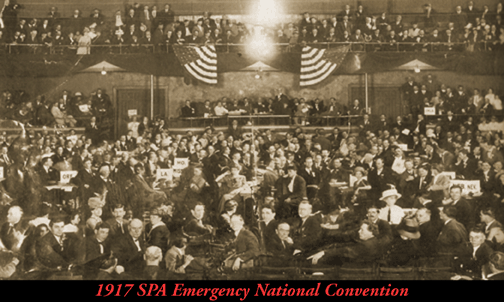
In 1917, during the St. Louis Convention, members of the Socialist Party gathered together, condemning the United States involvement in World War I.
The party's leader
Eugene V. Debs thought that the capitalist and imperialist nations were consumed with greed and only wanted war to gain power and domination of the world markets, therefore they stated that the United States was making a mistake by entering into the war.
The Socialist Party felt that "wars bring wealth and power to the ruling classes, and suffering, death and demoralization to the workers".
During the convention speakers painted a picture about the ugliness of war and plead to the masses, the workers of all countries, to refuse to support the war in Europe. The speaker wanted the working masses to realize that the government and "national groups of capitalists" had no concern for the working people. The speaker goes on to say that the masses are being misled to believe that the United States was entering the war to defend democracy, when in fact the United States is turning into the imperialist and militarist government just like the Europeans. Within the speech, the speaker explains many reasons why the war would not accomplish anything.

The speaker also points out that even thought the German's U-Boat attack was ruthless, "it was not an invasion of the rights of the American people", and attempts to validate the argument against United States involvement in the war by stating the following:

"...Militarism can never be abolished by militarism", "...Democracy can never be imposed upon any country by a foreign power by force of arms", and "...if we send an armed force into the battlefields of Europe, its cannons will mow down the masses of the German people and not the Imperial German Government".
The Socialist Party of the United States felt that entering the war was going to senselessly kill the masses of innocent working classes in order for the capitalists to profit. The speaker said that if we were fighting to end the struggle for freedom of the working class, then they would fight with all their will, however the Socialist's refused to let one working class member die to support the greed of capitalism or militarism.

Saturday, February 21, 2009

Plessy v. Ferguson (1896)


Even though slavery was abolished after the Civil War, Southern States continued to treat African Americans differently.
Governments within the southern states passed Jim Crow laws which prohibited blacks from using the same public accommodations as the whites. Louisiana passed the Separate Car Act(1890).

This act justified that separate accommodations for blacks and whites on railroad cars was within the law as long as the accommodations were equal in quality.
A group of both white and black activists from New Orleans organized the Citizen's Committee to Test the Separate Car Act to challenge the constitutionality of the Separate Car Law.

The organization raised money to hire a lawyer to defend them. When Albion W. Tourgee was approached, he agreed to help at no cost to the Citizen's Committee. The group found Homer A. Plessy, who was 1 eighth black and 7 eighth white, to deliberately break the segregation ruling. Although Plessy could pass as white, he announced that he had an African American ancestor. He was arrested on June 7, 1892 and his case reached the U.S. Supreme Court in 1896.
In a majority decision, Justice Henry Brown handed down the verdict that the Louisiana Separate Car Act did not violate the 13th Amendment nor did it violate the 14th Amendment of the Constitution. The reasoning was that the case did not involve the act of enslaving of Homer Plessy(13th) and the 14th Amendment was not violated because was created only for the right of African Americans to vote and serve on juries. It did not protect the social rights of African Americans.

"we cannot say that a law which authorizes or even requires the separation of the two races in public conveyances is unreasonable, or more obnoxious to the Fourteenth amendment than the acts of Congress requiring separate schools for colored children in the District of Columbia"
"...the assumption that the enforced separation of the two races stamps the colored race with a badge of inferiority.....(is) solely because the colored race chooses to put that construction upon it"
As a result of this ruling Homer Plessy had to pay the fine. The ruling of Plessy v. Ferguson also served as the legal justification for racial segregation within the public sphere ultimately creating a racial caste society. There would continue to be segregation for over 50 years, until Brown v. Board of Education (1954) over turned the decision.
http://www.bgsu.edu/departments/acs/1890s/plessy/plessy.html

Tuesday, February 10, 2009

Judge Not a Man by the Cost of his Clothing


During the Age of Progress, in the late 19th century, investors like Cornelius Vanderbilt created great wealth within the railroad corporations and George Westinghouse made his fortunes in large part because of his advances in railroad technology by inventing the automatic coupler. While these men and other capitalists were part of the elite, the laborers in the coal and iron ore mines were suffering from poverty. They worked long hours under harsh conditions for little pay.

The ballad Judge Not a Man by the Cost of his Clothing, written anonymously, exemplifies the social class differences that were developing in this time period.

Give me the man as a friend and a neighbor,
Who toils at the spade, the loom or the plough,
Who wins his deploma of manhood by labor...
Then why should the broadcloth alone be respected,
And the man be despised who is fustian appears.

Within these two stanzas, the author explains his fustrastion with the attitudes of the rich. He is thought of as less of a man because he is poor and can only afford clothing made from twilled cotton or low-quality wool. He wants to be judged for his character because he thinks of himself as a good man that is hard working, yet he is looked down upon because of his wardrobe.

Sunday, February 8, 2009

Survival of the fittest in society

In this post we will take a quick glance at the views of William Graham Sumner who was an economics and sociology professor at Yale University. Sumner followed a "Social Darwinism" believe. He based his social ideas on the theories of Charles Darwin who first proposed the idea of natural selection and survival of the fittest in nature.

William Graham Sumner
Sumner discusses in his reading "What Social Classes Owe to Each Other" the idea that even in our complex society we are still bound by the laws of Nature. In this case the theory on natural selection which favors best suited organisms for competition of the limited resources available. He suggests that by having programs in society that take from an individual to give to another who is not productive and does not contribute to society is a burden and detrimental to our long term survival as a society. Our society is about equality of opportunity. The more opportunity that's available the more disparity in social classes because some will choose to take advantage while others will choose not to. The greatest help we can provide people in need is the advancement of science, government and society. This will in turn better the chances of individuals but not necessarily guarantee equality. As Sumner said:

"The man who by his own effort raises himself above poverty appears, in these discussions to be of no account. The man who has done nothing to raise himself above poverty finds that the social doctors flock about him, bringing the capital which they have collected from the other classes, and promising him aid of the State to give him what other had to work for." William Graham Sumner " What Social Classes Owe to Each Other" 2.1: The Industrial Status Quo Defended (1833)
If we take the Social Darwinist view and apply it to the period of time between late 1800s and early 1900s where large scale enterprises played such an important role, we can see that industrialists such as Andrew Carnegie and John D. Rockefeller who took advantage of the opportunities in the market and in the process created thousands of jobs for those who wanted to be productive and chose not to be a burden on society.
This problem transcends time into our own. What do we do with members of society who need financial help and do not contribute to our economy.? Many of us approve of aid such as the Federal Welfare programs while others think that it's a waste of tax payers money and many are abusing it.

Thursday, October 30, 2008

William Jennings Bryan: Imperialism vs. Expansionism


In his speech delivered on December 13, 1898 in Savannah, Ga., democrat William Jennings Bryan expressed his concern about America's increased interest in what clearly resembled the ideology of European Imperialism. He believed the concept of Imperialism to go against the very essence upon what America was based. In his own words:
"The imperialistic idea is directly antagonistic to the idea and ideals which
have been cherished by the American people since the signing of the Declaration
of Independence."

Bryan did not opposed the concept of expansion, as long as there were clear beneficial reason to justify it, such as securing contiguous territory for future settlement. Also, he was in favor of expanding to surrounding areas, but against expanding to remote areas, which he considered impractical.
"The Philippine Islands are too far away and their people too different from us
to be annexed to the United States, even if they desired it."
In this regard, Bryan believed that the issues with Cuba and Philippines should be handled in similar manner. He argued that the best policy was to take possession of this countries only to try to establish a stable government and then hand the government back to their people.


McKinley's Emancipation of the Phillipines


On February 17, in 1899 President William McKinley made a speech about the United State's involvement in the Phillipines. Almost immediately after the signing of the Treaty of Paris which officially ended the Spanish American War, conflict broke out between the United State's troops occuppying the Phillipines and Filipinos who felt that the Imperial Spain was being replaced with an Imperial United States.


In President McKinley's speech entitled "Emancipators not Masters" he denounces the claims that imperialism is the United State's motive. McKinley claims that American forces were responsibly standing up for the oppressed people of the Spanish territories. He states " But grave problems come in the life of a nation, however much men seek to avoid them. They come without our seeking... But the generation in which they are forced cannot avoid the responsibility of honestly striving for their solution." In this quotation McKinley admits the responsibility the United States had, and even refers to his earlier opposition of the Spanish-American War.


President McKinley goes on to state that the United State's will aid the Phillipines in constructing a new government. He states " That they (Phillipines) will have a kindlier government under our guidance, and that they will be aided in every possible way to be self-respecting and self-governing people...". This quote really caught my attention because it sounded so familiar. It seems to be the exact message that the Bush administration has put forth in order to justify the continuation of the War in Iraq. In addition to the justifications of the McKinley and Bush administration being similar, so is the criticism of both military efforts. The American occupation of formerly Spanish territories, also draws an uncanny resemblance to the continuing occupation of Middle Eastern territories and both Wars were criticized of having imperialistic motives.

Tuesday, October 28, 2008

U.S. Grant: An Appeal for the Annexation of Santo Domingo


U.S. Grant, "Appeal for the Annexation of Santo Domingo," May, 1870.

"I transmit to the Senate, for consideration with a view to its ratification, an additional article to the treaty Of the 29th of November last, for the annexation of the Dominican Republic to the United States, stipulating for an extension of the time for exchanging the ratifications thereof, signed in this city on the 14th instant by the plenipotentiaries of the parties.

It was my intention to have also negotiated with the plenipotentiary of San Domingo amendments to the treaty of annexation to obviate objections which may be urged against the treaty as it is now worded; but on reflection I deem it better to submit to th e Senate the propriety of their amending the treaty as follows: First, to specify that the obligations of this Government shall not exceed the $1,500,000 stipulated in the treaty; secondly, to determine the manner of appointing the agents to receive and disburse the same; thirdly, to determine the class of creditors who shall take precedence in the settlement of their claims; and, finally, to insert such amendments as may suggest themselves to the minds of Senators to carry out in good faith the condit ions of the treaty submitted to the Senate of the United States in January last, according to the spirit and intent of that treaty. From the most reliable information I can obtain, the sum specified in the treaty will pay every just claim against the Re public of San Domingo and leave a balance sufficient to carry on a Territorial government until such time as new laws for providing a Territorial revenue can be enacted and put in force.

I feel an unusual anxiety for the ratification of this treaty, because I believe it will redound greatly to the glory of the two countries interested, to civilization, and to the extirpation of the institution of slavery.

The doctrine promulgated by President Monroe has been adhered to by all political parties, and I now deem it proper to assert the equally important principle that hereafter no territory on this continent shall be regarded as subject of transfer to a Euro pean power.

The Government of San Domingo has voluntarily sought this annexation. It is a weak power, numbering probably less than 120,000 souls, and yet possessing one of the richest territories under the sun, capable of supporting a population of 10,000,000 people in luxury. The people of San Domingo are not capable of maintaining themselves in their present condition, and must look for outside support.

They yearn for the protection of our free institutions and laws, our progress and civilization. Shall we refuse them?

I have information which I believe reliable that a European power stands ready now to offer $2,000,000 for the possession of Samana Bay alone. If refused by us, with what grace can we prevent a foreign power from attempting to secure the prize?

The acquisition of San Domingo is desirable because of its geographical position. It commands the entrance to the Caribbean Sea and the Isthmus transit of commerce. It possesses the richest soil, best and most capacious harbors, most salubrious climate , and the most valuable products of the forests, mine, and soil of any of the West India Islands. Its possession by us will in a few years build up a coastwise commerce of immense magnitude, which will go far toward restoring to us our lost merchant mari ne. It will give to us those articles which we consume so largely and do not produce, thus equalizing our exports and imports.

In case of foreign war it will give us command of all the islands referred to, and thus prevent an enemy from ever again possessing himself of rendezvous upon our very coast.

At present our coast trade between the States bordering on the Atlantic and those bordering on the Gulf of Mexico is cut into by the Bahamas and the Antilles. Twice we must, as it were, pass through foreign countries to get by sea from Georgia to the wes t coast of Florida.

San Domingo, with a stable government, under which her immense resources can be developed, will give remunerative wages to tens of thousands of laborers not now on the island.

This labor will take advantage of every available means of transportation to abandon the adjacent islands and seek the blessings of freedom and its sequence -- each inhabitant receiving the reward of his own labor. Porto Rico and Cuba will have to abolis h slavery, as a measure of self-preservation to retain their laborers.

San Domingo will become a large consumer of the products of Northern farms and manufactories. The cheap rate at which her citizens can be furnished with food, tools, and machinery will make it necessary that the contiguous islands should have the same ad vantages in order to compete in the production of sugar, coffee, tobacco, tropical fruits, etc. This will open to us a still wider market for our products.

The production of our own supply of these articles will cut off more than one hundred millions of our annual imports, besides largely increasing our exports. With such a picture it is easy to see how our large debt abroad is ultimately to be extinguished . With a balance of trade against us (including interest on bonds held by foreigners and money spent by our citizens traveling in foreign lands) equal to the entire yield of the precious metals in this country, it is not so easy to see how this result i s to be otherwise accomplished.

The acquisition of San Domingo is an adherence to the "Monroe doctrine;" it is a measure of national protection; it is asserting our just claim to a controlling influence over the great commercial traffic soon to flow from east to west by the way of the Isthmus of Darien; it is to build up our merchant marine; it is to furnish new markets for the products of our farms, shops, and manufactories; it is to make slavery insupportable in Cuba and Porto Rico at once and ultimately so in Brazil; it is to settl e the unhappy condition of Cuba, and end an exterminating conflict; it is to provide honest means of paying our honest debts, without overtaxing the people; it is to furnish our citizens with the necessaries of everyday life at cheaper rates than ever be fore; and it is, in fine, a rapid stride toward that greatness which the intelligence, industry, and enterprise of the citizens of the United States entitle this country to assume among nations."

Thursday, October 2, 2008

The "Unwritten Law"


Ida Wells-Barnett can be applauded just for the fact that at the time of oppression against African- Americans, and women in the early 20th century she is credited for "enlightening the nation and the world about the powerful connection between lynching, patriarchy, racism, and cultural notions of white womanhood and black sexuality."


In her piece entitled "Lynch Law in America", Wells-Barnett attacks the social acceptance of lynch laws. With the rise of racist organizations such as the "red shirts' and the Ku Klux Klan the torturing and murdering of African Americans had become a trademark of the legal system. Wells-Barnett explains how this "unwritten law is not attributed solely to the South, but is actually a national injustice.


As her case against lynch laws progress Wells-Barnett displays how lynching is almost unavoidable.
"If a few barns were burned some colored man was killed to stop it. If a colored man resented the imposition of a white man and the two came to blows, the colored man had to die, either at the hands of the white man then and there or later at the hands of a mob that speedily gathered. If he showed a spirit of courageous manhood he was hanged for his pains, and the killing was justified by the declaration that he was a "saucy nigger." Colored women have been murdered because the refused to tell mobs where relatives could be found for lynching."


Wells-Barnetts' piece was written in 1900, thirty-years after the passage of the 15th amendment which guaranteed the right to vote as well as citizenship of the African-American population. With that amendment ratified, it meant that African American citizens were protected under the same federal laws as white citizens. Furthermore the Bill of Rights fully applied to all African-Americans. Lynch laws violate the Fifth amendment which guarantees due process, the Sixth amendment which guarantees trial by jury, and the Eighth amendment of cruel and unusual punishment. Ida Wells-Barnett also describes instances where the Fourth amendment of unwarranted search and seizure as well as the Seventh amendment of civil trial by jury had been violated. Even more distressing is the instances in which Wells-Barnett describes how witnesses, or family members, individuals who were guilty of no crime were murdered because the refuse to answer unlawful questioning.

The execution of completely Innocent bystanders, even children is exemplified in Wells-Barnett's story of a boy and girl executed, for no offense at all.

"In the case of the boy and girl above referred to, their father, named Hastings, was accused of murder of a white man. His fourteen-year-old daughter and sixteen-year-old son were hanged and their bodies filled with bullets; then the father was also lynched."

As I continued to read the article I was amazed at how the claims of white woman were openly accepted in so many cases. Wells-Barnett explains the popularity of white woman making unjustified claims predominately against black men. Sometimes it appears, due to the fact that they had been caught in an interracial relationship, had made false claims to protect themselves. I find this particularly interesting because it was common for the courts to disregard a woman's testimony in the court system without any male witnesses, especially in cases of rape.

Overall it appears that these lynching laws were prime examples of the horrors that can occur when a mob mentality dominates groups of people. I believe this period of time, will always be shamefully remembered on the pages of American History.

Thursday, September 11, 2008

Samuel Gomper's Realization


Samuel Gompers was an outspoken advocate of labor reform. His distinctive view of "pure and simple" unionism called for labor movements to concentrate on "concrete, achievable gains" and better organization of specific workforces (Henretta, 496). His strategic genius and call for structure resulted in him becoming "the first and longest serving president of the American Federation of Labor (AFL)".
Samuel Gomper recalls the events that helped shape his opinion on unions in his writings titled "Chapter V: I Learn the Weakness of Radical Tactics ". In this passage he describes, first hand the events surrounding and leading up to the explosion of violence and police brutality against union movements at Tompkins Square in New York City. In his denouncing of radical tactics Gomper states:

"I saw how professions of radicalism and sensationalism concentrated on all the forces of organized society against a labor movement and nullified in advance normal, neccessary activity. I saw the leadership in the labor movement could be safely entrusted only to those into whose hearts and minds had been woven the experiences of earning their bread by daily labor. I saw the betterment of workingmen must come primarily through workingmen. I saw the danger of entangling alliances with intellectuals who did not understand that to experiment with the labor movement was to experiment with human life."
This quote identifies the key flaws in the early labor movement including division, untrustworthy and "out of touch" leadership as well as the public disdain for radical tactics. His analysis proved true for the labor movements of the 19th century, as well as social movements that have taken place throughout history.

Thursday, September 4, 2008

A woman before her time, Elaine Goodale Eastman

American woman in 1889, don’t have the right to vote, yet Elaine Goodale Eastman is appointed as Supervisor of Education in the two Dakotas. She is given a budget of thirty thousand dollars a year to manage and build a day school system for Indian child. She travels independently through a territory known to most Americans as the Wild West. She’s smart, curious and brave in a time when women are perceived as second class citizens. But, her most important attribute is the strength of her conviction to follow her calling as a teacher, writer, and compassionate servant to the disenfranchised Indian Nation of the Northern Plains. She believes passionately that education is a key factor if the next generations of Indians are to assimilate into American society.

When she arrives in Standing Rock, North Dakota in 1890; the last stop on her trip to survey new school locations, she’s devastated by the state of the Indian people.‘

"Lean and wiry in health, with glowing skins and a look of mettle, many now displayed gaunt forms, lackluster faces, and sad, deep-sunken eyes.”(p. 137)
Most Americans blame the Indians for the poor conditions that exist on Indian Reservations. They stereotype the Native American Indian's as lazy and unwilling to work, just waiting for their next government handout. After living with the Indians, learning their language and culture, Eastman knows this is not true. Also, working as a government administrator, she understands both side of this sad story. In the follow quote she explains her point of view.

“Yet all alike were victims of the natural calamity of the drought and of the broken promises of our government. It might well be said that we wronged the Indians most, not when we destroyed their wild herds or drove them from their vast ranges, but when we delayed too long the recompense of an equal share in the more advanced culture that inevitably displaced their own.” (p. 138)

Elaine Goodale Eastman ends her story without tell us what happened to the school program. Did it survive after the massacre at Wounded Knee?