Thursday, December 6, 2012

House Judiciary Committee, Articles of Impeachment


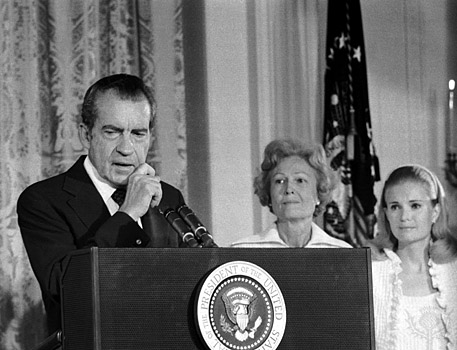
House of judiciary Committee, Article of Impeachment Agustin 20, 1974

Richard Nixon ran for presidency in 1960, but lost to John F. Kennedy. After running for Governor of California once again and coming up short he stated that he was finished with politics. However, he ran again in 1972, this time, he was successful. Nixon won against Democrat George McGovern by 60 percent of popular votes.

Throughout is Presidency Nixon carried out much dishonestly for personal advantages that were unlawful. During his time in office, President Nixon and his major assistants became deeply involved in illegal activities against the opposing committee.
At first he denied the incident inside the Watergate Office Complex in Washington the democratic national committee headquarters, where five burglars broke-in to try to record the opposing candidate’s conversation to try and get a step up on the competition. They were arrested by the police at 2:30 a.m. The investigators found out that the burglars were employed by President Nixon. President Nixon denied it by stating   "No one in the White House staff, no one in this administration presently employed, was involved in this way bizarre incident”   Nether the less, The House Judiciary Committee began its final debate on the impeachment of President Nixon for his illegal activities surrounding the Watergate scandal on July 24, 1974. They came up with three articles for President Nixon impeachment.


Article 1: Obstruction of Justice.

This article stated that the full House should impeach Nixon for the high crime of deliberately engaging in obstruction of justice by attempting to cover up the Watergate investigation. Nixon Designed to delay, impede and obstruct investigations of such unlawful entry; to cover up, conceal and protect those responsible and to conceal the existence and scope of other unlawful covert activities. Passed by vote of 27 to 11.

Article 2: Abuse of Power.

It charged the president with abuse of powers, in violation of the Constitution, by using the IRS, the FBI, and other government agencies to spy on American citizens. Nixon repeatedly engaged in conduct violating the constitutional rights of citizens, imparting the due and proper administration of justice and the conduct of lawful inquiries, or contravening the laws governing agencies of the executive branch and the purposes of these agencies. Passed by vote of 28 to 10

Article 3: Contempt of Congress.

It charged that Nixon violated the Constitution by ignoring congressional subpoenas of White House documents. In refusing to produce these papers and things, Richard M. Nixon, substituting his judgment as to what materials were necessary for the inquiry, interposed the powers of the Presidency against the lawful orders of the House of Representatives, thereby assuming to himself functions and judgments necessary to the exercise of the sole power of impeachment vested by Constitution in the House of Representatives. Passed by a vote of 21 to 17
By,
Nick Brengel, Shantana Folkes

Senator J. William Fulbright on the Arrogance of Power, 1966


The attitude above all others which I feel sure is no longer valid is the arrogance of power, the tendency of great nations to equate power with virtue and major responsibilities with a universal mission. The dilemmas involved are preeminently American di lemmas, not because America has weaknesses that others do not have but because America is powerful as no nation has ever been before and the discrepancy between its power and the power of others appears to be increasing....


We are now engaged in a war to "defend freedom" in South Vietnam. Unlike the Republic of Korea, South Vietnam has an army which [is] without notable success and a weak, dictatorial government which does not command the loyalty of the South Vietn amese people. The official war aims of the United States Government, as I understand them, are to defeat what is regarded as North Vietnamese aggression, to demonstrate the futility of what the communists call "wars of national liberation," and to create conditions under which the South Vietnamese people will be able freely to determine their own future. I have not the slightest doubt of the sincerity of the President and the Vice President and the Secretaries of State and Defense in propounding these aims. What I do doubt_and doubt very much_is the ability of the United States to achieve these aims by the means being used. I do not question the power of our weapons and the efficiency of our logistics; I cannot say these things delight me as the y seem to delight some of our officials, but they are certainly impressive. What I do question is the ability of the United States, or France or any other Western nation, to go into a small, alien, undeveloped Asian nation and create stability where there is chaos, the will to fight where there is defeatism, democracy racy where there is no tradition of it and honest government where corruption is almost a way of life. Our handicap is well expressed in the pungent Chinese proverb: "In shallo w waters dragons become the sport of shrimps."


Early last month demonstrators in Saigon burned American jeeps, tried to assault American soldiers, and marched through the streets shouting "Down with the American imperialists," while one of the Buddhist leaders made a speech equating the Unit ed States with the communists as a threat to South Vietnamese independence. Most Americans are understandably shocked ant angered to encounter such hostility from people who by now would be under the rule of the Viet Cong but for the sacrifice of American lives and money. Why, we may ask, are they so shockingly ungrateful? Surely they must know that their very right to parade and protest and demonstrate depends on the Americans who are defending them.


The answer, I think, is that "fatal impact" of the rich and strong on the poor and weak. Dependent on it though the Vietnamese are, our very strength is a reproach to their weakness, our wealth a mockery of their poverty, our success a reminder of their failures. What they resent is the disruptive effect of our strong culture upon their fragile one, an effect which we can no more avoid than a man can help being bigger than a child. What they fear, I think rightly, is that traditional Vietnamese society cannot survive the American economic and cultural impact....


The cause of our difficulties in southeast Asia is not a deficiency of power but an excess of the wrong kind of power which results in a feeling of impotence when it fails to achieve its desired ends. We are still acting like boy scouts dragging reluctant old ladies across the streets they do not want to cross. We are trying to remake Vietnamese society, a task which certainly cannot be accomplished by force and which probably cannot be accomplished by any means available to outsiders. The objective may b e desirable, but it is not feasible....


If America has a service to perform in the world_and I believe it has_it is in large part the service of its own example. In our excessive involvement in the affairs of other countries, we are not only living off our assets and denying our own people the proper enjoyment of their resources; we are also denying the world the example of a free society enjoying its freedom to the fullest. This is regrettable indeed for a nation that aspires to teach democracy to other nations, because, as Burke said! "E xample is the school of mankind, and they will learn at no other." . . .


There are many respects in which America, if it can bring itself to act with the magnanimity and the empathy appropriate to its size and power, can be an intelligent example to the world. We have the opportunity to set an example of generous understanding in our relations with China, of practical cooperation for peace in our relations with Russia, of reliable and respectful partnership in our relations with Western Europe, of material helpfulness without moral presumption in our relations with the develop ing nations, of abstention from the temptations of hegemony in our relations with Latin America, and of the all- around advantages of minding one's own business in our relations with everybody. Most of all, we have the opportunity to serve as an example o f democracy to the world by the way in which we run our own society; America, in the words of John Quincy Adams, should be "the well-wisher to the freedom and independence of all" but "the champion and vindicator only of her own." . . .


If we can bring ourselves so to act, we will have overcome the dangers of the arrogance of power. It will involve, no doubt, the loss of certain glories, but that seems a price worth paying for the probable rewards, which are the happiness of America and the peace of the world.

By: Zully Arias , Imarys Bruno

CRISIS OF CONFIDENCE ADDRESS by Jimmy Carter

CARTER CONSERVATISM ARTICLE
http://www.theamericanconservative.com/articles/carter-conservatism/

CARTER'S SPEECH
http://www.pbs.org/wgbh/americanexperience/features/primary-resources/carter-crisis/

Declaration of Environmental Rights 1970 by LINDSAY MISCHKE


In the 1950’s and the 1960’s, economic growth was powered by oil.  The United States produced more oil than they actually used or needed.  Large offshore deposits of oil were discovered off of the California coast, and in order to obtain this oil, a new technology of underwater drilling had to be done which was dangerous.  In the winter of 1969, off the coast, lots of sticky black petroleum floated up to the top and suffocated thousands of fish and trapped many seabirds.

·        Fish, birds & oil washed up on shore, ruining many beaches

·        Santa Barbara was affected the most

A group of angry citizens came together to protect the environment and to state how mad they were about the wasteful ways of Americans.  Although the economic growth was a success, it was overshadowed by the harm it did to the natural world.  Humans have been abusing the world for many years now.  The environmental disaster of the Santa Barbara channel brought many environmental issues up:

§  Littering

§  Humans have taken up much natural land

§  We have stripped the forest and grasses and reduced the soil

§  We contaminate the air WE breathe

§  Pollution of the lakes, rivers & oceans

§  We have exterminated species of birds and animals and brought others close to  it

§  “Made physical world ugly and loud depriving man of the beauty and quiet that feeds his spirit.” (Hofstadter p. 507)

We are able to solve this problem by simply using our minds, not machines.  People need to realize that man is a member of his community, not the master of it.  We must treat our backyards as if they were the world and the world as if it were our backyard. 

“TODAY IS THE FIRST DAY OF THE REST OF OUR LIFE ON THIS PLANET, WE WILL BEGIN ANEW.” (Hofstadter p. 508)

                  A recent article relating to a recent BP deepwater oil spill..
"Offshore drilling is inherently dirty and dangerous and needs to be phased out."


Tuesday, December 4, 2012

Nuclear weapons and Cold War

President John F. Kennedy once said in his speech addressing nuclear testing during The Cold War era. "The treaty initiated yesterday... is a limited treaty which permits continued underground testing and prohibits only those tests that we ourselves can police. It requires no control posts, no on-site inspection, no international body. ...no nation's rights of self- defense will in any way be impaired. Nor does this treaty mean the end of the nuclear war. It will not reduce nuclear stockpiles; it will not halt the production of nuclear weapons; it will not restrict their use in their time of war. Nevertheless, it will reduce the nuclear testing which would otherwise be conducted on both sides; it will prohibit the United States, United Kingdom, Soviet Union, and all others who sign it from engaging in the atmospheric tests which have so alarmed mankind; and it offers to all the world a welcome sign of hope"
nuclear testing cartoons, nuclear testing cartoon, nuclear testing picture, nuclear testing pictures, nuclear testing image, nuclear testing images, nuclear testing illustration, nuclear testing illustrations

John f Kennedys Inaugural Adress

On January 20 1961, John F kennedy took an oath in office to became the nations 35th president. The Cold War had dominated the rhetoric of both Kennedy and Nixon's campaign. Through his breif inaugural address, Kennedy sought to send a  message of his hope for peace during the nuclear age.

"Let every nation know, whether it wishes us well or ill, that we shall pay any price, bear any burden, meet any hardship, support any friend, oppose any foe, in order to assure the survival and the success of liberty."

 In a time period of insescurity and distrust a speech  was needed.The period refferred to as the Cold War revolvesd around the relationship that developed between the USA and the USSR. It was meant to settle International affairs such as the Cuban Missle Crisis, and the Berlin Wall.

"To our sister republics south of our border, we offer a special pledge—to convert our good words into good deeds—in a new alliance for progress—to assist free men and free governments in casting off the chains of poverty. But this peaceful revolution of hope cannot become the prey of hostile powers. Let all our neighbors know that we shall join with them to oppose aggression or subversion anywhere in the Americas. And let every other power know that this Hemisphere intends to remain the master of its own house...
our last best hope in an age where the instruments of war have far outpaced the instruments of peace, we renew our pledge of support—to prevent it from becoming merely a forum for invective—to strengthen its shield of the new and the weak—and to enlarge the area in which its writ may run.
Finally, to those nations who would make themselves our adversary, we offer not a pledge but a request: that both sides begin anew the quest for peace, before the dark powers of destruction unleashed by science engulf all humanity in planned or accidental self-destruction."
 
Kennedy provided a sense of security, and reassurance throughout his inaugral speech. This with the addition of his confident aura play a part in making the inaugural address a historical landmark. 


Thursday, November 29, 2012

Hello professor!!!!! :)

Wednesday, October 17, 2012

Locomotive


    Song of the Locomotive is a song praising the freight and passenger

railroads that eventually linked the Atlantic and Pacific coasts of the United

States. Trains have been a theme in popular music since the start of the

Railroad Era in the 1830’s. Railroads were  the first large scale business

enterprises replacing canals and rivers. Railroads made possible

 the transition to an industrial nation by opening up remote areas and

stimulating new industries. Railroads linked major manufacturing and

agricultural areas. For example, by 1856, the Great Lakes and the Mississippi

River had railroad crossings.  
               In the Song, the locomotive is portrayed as a powerful force of
nature when it is described as having the speed of a mountain eagle in flight 
The train is also given human traits by stating that it travels  ‘’with a scream
and a scowl of scorn’’. Vast amounts of land were given or sold by the new
American government for railroad development and the American landscape
and its people experienced radical changes. The violence  related to the
building of the railroad is expressed in the song by the use of the words
‘slaughtered’ and ‘mangled’.  The lyrics do not apologize for the locomotive’s 
 iron path’ of destruction.  In fact, the lyrics of the song are of a boasting
nature. The lyrics boast about the wealth that the train carries.  The
locomotive takes pride in passing through beach, desert and busy city streets.
There is also boasting about being able to withstand all weather conditions
such as ‘’burning  heat and cold winter”.  In reality, the railroad was superior
to canals and rivers which froze during the winter.
          As stated in class, the 1860’s was a culture of poems. In the Song of
the Locomotive, the locomotive is personified as a ‘king’  who rules over and
strikes fear in his subjects.  The ‘loud thunder like noise’ and smoke is seen
and heard all day long from sunrise to midnight.  The Song of the Locomotive
is a vivid testament to the impact of the railroad on American life.  

Monday, October 1, 2012

Booker T. Washington, Up From Slavery and 1895 Slave Exposition


Booker T. Washington renowned educator, author and African-American leader released his autobiographical classic Up From Slavery in 1902. While undoubtedly a historic figure in American History Washington was also controversial, one criticized aspect of him was his stance on labor and black-white relations. In chapter 10 of Up From Slavery titled “A Harder Task Than Making Bricks Without Straw” Washington delves deeper into his thoughts on labor. Washington believed that it was essential for blacks to learn a trade rather than to indulge in literary academics. The belief of teaching students labor is written in the beginning of the chapter when Booker T. writes

“My plan was to have them, while performing this service, taught the latest and best methods of labor, so that the school would not only get the benefit of their efforts, but the students themselves would be taught to see not only utility in labor, but beauty and dignity, would be taught, in fact, how to lift labor up from mere drudgery and toil, and would learn to love work for its own sake. My plan was not to teach them to work in the old way but to show them how to make the forces of nature—air, water, steam, electricity, horse-power --- assist them in labor” – Booker T. Washington

Washington had students construct the Institutes many buildings and while many opposed this idea of having inexperienced students work construction the plan never changed. Washington felt the experience of building was essential for the student.  Washington believed that an emphasis on labor would better prepare black people to contribute to their respective communities immediately and more effectively than book knowledge, Washington wrote that

“The actual sight of a first class house that a Negro has built is ten times more potent than pages of discussion about a house that he ought to build, or perhaps could build.

There was much controversy however on Washington’s firm stance on the importance of labor to the advancement of black people. Many parents who sent their children to Tuskegee Institute were against the idea of their child predominantly being taught various trades of labor. Most likely this belief stemmed from slavery being abolished only abolished 37 years before, with the overall majority of slaves not being permitted and only knowing labor it is understandable why they would be opposed to idea of sending their student to school to do more labor. Washington writes on this matter and subtly criticizes the parents decision

“Most of the new student brought a written or a verbal request from their parents to the effect that they wanted their children taught nothing but books. The more books, the larger they were, and the longer the titles printed upon them, the better pleased the students and their parents seemed to be”

Washington, T. Booker. (1902). A Harder Task Thank Making Bricks Without Straw” Lyman Abbott (Ed.), Up From Slavery (pp. 108-112)


On September 18th, 1895 Booker T. Washington delivered his historical Atlanta Exposition speech. The speech is considered one of his most acclaimed achievements. Booker T. Washington is generally celebrated for being the keynote speaker and delivering an historic speech, there some controversy. Most famously W.E.B DuBois but through out history there has been much discussion concerning Washington’s message. DuBois like other critics felt that Washington compromised to much especially considering that slavery had just ended 30 years before that. One quote that may have given critics this belief is

As we have proved our loyalty to you in the past, in nursing your children, watching by the sick-bed of your mothers and fathers, and often following them with tear-dimmed eyes to their graves, so in the future, in our humble way, we shall stand by you with a devotion that no foreigner can approach, ready to lay down our lives,

This one quote good be used as the basis of the criticism, it describes slavery in a very peaceful and friendly way. Also the part about devotion most likely was also a trigger, to suggest black people should have devotion towards white people so soon after slavery and with segregation and civil rights still major social issues it would be seen as insensitive to black people.. Booker T. also spoke of how if blacks did not collaborate with whites they were aiding in the destruction of America. Booker T. says

“Nearly sixteen millions of hands will aid you in pulling the load upward, or they will pull against you the load downward.

These two points would be easy pointers for critics to use against Washington’s speech

Tuesday, September 18, 2012

Welcome!

Welcome to the American People II blog. For those of you who have never posted to a blog before here are some simple guidelines:

  • Posting: Use this blog to post about anything relating to the readings, lectures and class discussions. You can also post about current events that relate to the issues raised this semester.
  • Presentation Posts: Posts are required for oral presentations. A presentation post should include any short quotations, links, images, or video, that you might wish to use in your presentation.
  • Read before Posting: Always read the other posts on the blog before posting, don't repeat the same material as a previous post unless you have something to add to the discussion. Consider making a comment on a previous post instead of posting on the same topic.
  • Short Paragraphs & Quotations: Blogging is a short form. Posts do not have to be very long (two or three well written paragraphs.) Quality is more important than quantity. Use short quotations from the assigned readings, always cite your source clearly. Write brief, focused paragraphs.
  • Cite Sources Clearly: Always cite your sources clearly, using a link to the source material if possible. Use the author's full name, the title, and the page number, if possible.
  • Strong Links: A good post should include helpful links. Judicious use of links to key reference materials can ensure that your posts are short and to the point. Make sure you only link to authoritative, reliable sources of information.
  • Relevant Images: Use images that directly relate to the topic of your post. Don't post images just for window dressing. Ask yourself: does the image add to the substance of the post? Or is it just eye-candy? The same goes for videos.
  • Proof-read! Always proof-read and spell-check your post before publishing. Remember, spell-check does not check the spelling in the title of the post. A warning: this is a public blog and your posts will may be used during class discussion as well (big screen, 40 people reading your post,) so proof-read before publishing!
  • Comment: Reward good posts with praise and constructive criticism and discussion. Be prepared for comments from unknown sources that may not always be polite. Don't engage in flame wars with anonymous commenters.